At METRO, corporate responsibility (CR) is expressed through a rigorous approach to integrate environmental, social and governance (ESG) factors into our business practices. Our ambitions are driven by the commitment of our teams and executives to create value for METRO and society.
Nourish
the health and well-being of our communities
Our approach to corporate responsibility supports the achievement of the United Nations Sustainable Development Goals (SDGs), which guide the way to a better and more sustainable future for people and planet alike. We focus on the SDGs that underpin our purpose and where our impact is most significant, i.e. the following SDGs, while implementing actions that contribute to the other goals.







To learn more, see the
United Nations SDGs

As a food and pharmacy leader, we believe it is our duty to act every day to help create a sustainable and inclusive future for our customers, colleagues, communities and partners. As we are halfway through implementing our Corporate Responsibility (CR) Plan for 2022-2026, our rigorous approach in this regard, anchored in our business practices, continues to create long-term value for the company and our stakeholders. Once again this year, the work of our teams enabled us to make progress on our priorities, and we are on track to achieve most of our objectives within the next two years.
To boost our performance regarding environmental, social and governance (ESG) issues, we continue to evolve our executive compensation practices. In fiscal 2024, the Human Resources Committee of the Board of Directors approved the integration of ESG objectives into the long-term incentive plan for executives . The accountability of the company's Board of Directors and Executive Committee to our CR plan demonstrates the strength of our commitment.
ESG issues are subject to increasing regulation, with ever wider implications impacting all players in the supply chain. We are closely monitoring developments and preparing for the many impending legislative changes. The adoption of Bill S-211 is one example; to meet the requirements of this new legislation, we published in April 2024 our first Report under the Fighting Against Forced Labour and Child Labour in Supply Chains Act, which sets out the measures we have taken to prevent and mitigate the risk of forced labour or child labour in our operations. Our Supplier Code of Conduct for Responsible Procurement, published in 2017, reflects the importance we attach to this issue. We make considerable efforts to obtain the information required from our business partners to ensure that they comply with our Code. While the amount of information we need to collect from them continues to grow, our ongoing partnership with Sphera, formerly SupplyShift, enables us to assess our suppliers' practices and thus improve transparency within our supply chain.
The consequences of climate change are becoming increasingly visible, and we are aware of the urgency and necessity of implementing concrete measures to make the transition to a lower-carbon economy. Our strategy in this area focuses on five near-term science-based greenhouse gas (GHG) emission reduction targets. We are disclosing our results against these for the first time, and for the second year running, we are not only reporting our Scope 1 and 2 emissions, but also Scope 3 emissions from all relevant sources across our value chain.
Our efforts to reduce waste are paying off. For the first year, we have seen a significant improvement in our diversion rate, both in our stores and in our distribution centres.
Our long tradition of community involvement continues through both financial support and food donations. We are well on the way to achieving our objective of donating an amount equal to 1% of average net earnings in the last three fiscal years. METRO is Prism certified by Imagine Canada, an organization that recognizes leaders in philanthropy.
This year, we also continued our efforts to promote a diverse and inclusive organizational culture. The various actions we have implemented, such as the launch of two new training courses on mental health issues, have enabled us to make progress towards our equity, diversity and inclusion (ED&I) objectives. In 2025, we will continue to raise awareness and develop our colleagues' skills in this area.
I would like to acknowledge the tireless efforts of our teams, at all levels of the company, who worked on our ESG priorities throughout the year and strived to continue offering the best value to our customers in what continues to be a challenging economic environment for many. I am grateful to be able to count on the strength of our network of committed employees, merchants and pharmacist owners, who through their daily actions embody our purpose - to nourish the health and well-being of our communities.


In 2021, we conducted a materiality assessment to identify ESG issues on which we could take action and have the greatest impact on our business, society and our stakeholders.
Conducted in collaboration with an external consulting firm and in accordance with internationally recognized sustainability standards, this exercise enabled us to identify the ESG issues on which to base our 2022-2026 CR plan.
Materiality matrix
The METRO materiality matrix was guided by internationally recognized sustainability standards*.
X axis: topics with the greatest impact on METRO
Y axis: topics with the greatest influence on METRO stakeholder assessments and decisions
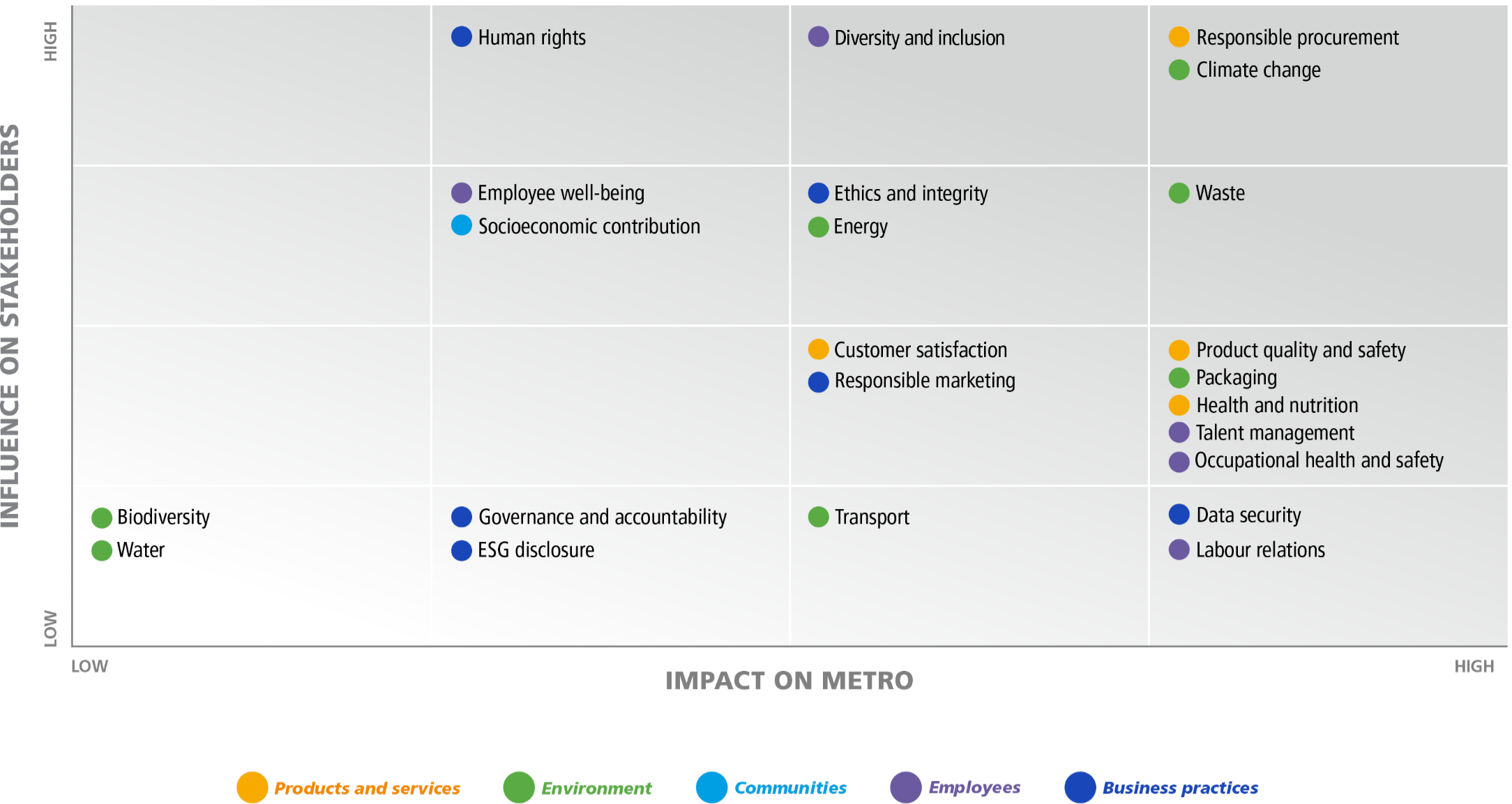
*Global Reporting Initiative (GRI) Standards, Sustainability Accounting Standards Board (SASB) Standards, AA1000 SES (Stakeholder Engagement Standard) by AccountAbility, United Nations Sustainable Development Goals (SDGs)
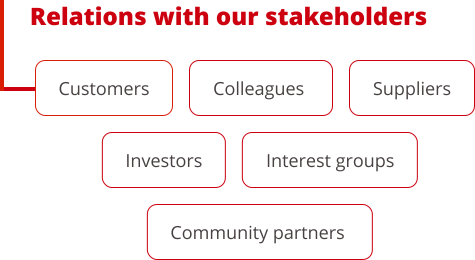
Our stakeholders are essential to our success. We know that we are stronger together and that achieving our corporate responsibility goals requires all stakeholders to be engaged and mobilized. Ongoing, transparent and effective communications with all our stakeholders is an important part of our corporate responsibility activities. It enables us to learn from various perspectives and experiences and build a common language to proactively address concerns relevant to our business.
For more information about our approach, see our 2022-2026 Corporate Responsibility Plan (PDF)
Our ambition is to implement responsible practices within our supply chain to offer our customers products that respect workers and the environment. This long-term task requires continuous issue monitoring, close collaboration with our suppliers and rigorous implementation programs.
Objectives
For information on our key performance indicators, see our 2022-2026 Corporate Responsibility Plan (PDF)
Our ambition is to support our customers in their daily actions to care for their health and well-being by offering products that meet their aspirations and nutritional needs and providing professional services to help them take concrete actions for their health. We intend to continue to play an active role in supporting public health through our network of neighborhood stores and pharmacies.
Objectives
Product offers
Professional services
For information on our key performance indicators, see our 2022-2026 Corporate Responsibility Plan (PDF)
Our ambition is to optimize our packaging and printed materials by reducing their use, relying on optimal design, choosing environmentally responsible materials and facilitating their recovery and recycling. These practices aim to reduce the use of resources, limit product losses and diminish waste generation, while contributing to the fight against single-use plastic.
Objectives1
Note 1: For more information, see our Packaging and Printed Materials Management Policy (PDF).
Our ambition is to reduce our greenhouse gas emissions to limit global warming by focusing our efforts on key sectors over which we have direct operational control. Through these actions, we aim to contribute to the collective effort to transition to a lower-carbon economy.
Objective
For information on our key performance indicators, see our 2022-2026 Corporate Responsibility Plan (PDF)
Our ambition is to avoid sending waste generated by our activities to landfill with the view to achieving zero waste at our locations, representing a diversion rate of at least 90%. We intend to enhance our performance by mobilizing our teams to optimize our operational practices.
Objective
For information on our key performance indicators, see our 2022-2026 Corporate Responsibility Plan (PDF)
Our ambition is to ensure that food that is safe for consumption and food residue generated by our activities are not thrown away. By redistributing them to organizations or giving them a second life, we are helping to address food insecurity and reduce the GHG emissions caused by landfilled organic waste.
Objective
For information on our key performance indicators, see our 2022-2026 Corporate Responsibility Plan (PDF)
Our ambition is to strengthen our actions to support an equitable, diverse and inclusive work environment that reflects the customers we serve. We also aim to provide customers with a shopping experience with which they identify in terms of product offer and customer service. We want our initiatives to be a driving force to accelerate the transition to a society rooted in ED&I values.
Objectives
For information on our key performance indicators, see our 2022-2026 Corporate Responsibility Plan (PDF)
Our ambition is to help reduce social inequalities, especially as they pertain to food and health. Building on our tradition of commitment since our founding in 1947, we count on the strength of our network of employees, merchants and pharmacist owners to contribute to the well-being of communities and generate sustainable benefits.
Objectives
For information on our key performance indicators, see our 2022-2026 Corporate Responsibility Plan (PDF)
Product quality assurance and food safety are an integral part of our efforts to provide our customers with products that are safe and of consistent quality and meet their needs.
As a retailer, franchisor, distributor and manufacturer, ensuring the quality and safety of the products available in our network of food stores and pharmacies constitutes one of our most important responsibilities toward consumers.
We make sure our private label suppliers meet standards of excellence and commit to the continuous improvement of their performances. Our teams implement rigorous control systems and provide the required level of oversight to ensure that products meet our specifications and all applicable product regulations.
We rely on close collaboration with our suppliers as well as detailed monitoring of our products and their performances in order to improve our understanding of our suppliers’ quality and regulatory compliance systems.
For more details on our achievements, see the 2024 Corporate Responsibility Report (PDF)
The health and well-being of our colleagues are primary conditions for us to truly embody our purpose and ensure our organizational effectiveness. We therefore build on occupational health and safety, respectful labour relations, talent management and an ethical, inclusive, respectful and positive work environment.
We are committed to providing an equitable and inclusive work environment in which our employees’ talents and aspirations are valued and developed and which reflects our willingness to promote the highest standards of ethics and integrity.
We take actions to continue to improve our culture of occupational health and safety to prevent accidents, injuries and occupational diseases and maintain good relations with all our employees and the unions that represent them by fostering open communication and the motivation to implement mutually beneficial agreements.
In the context of the current workforce challenges and evolution of customer expectations, we must ensure we have skilled colleagues today and in the years to come.
For more details on our achievements, see the 2024 Corporate Responsibility Report (PDF)
With hundreds of service points, we depend on a number of computer systems that are essential to our operations. In the normal course of business, we collect significant quantities of data from our customers, suppliers, employees and partners, as well as from the patients of our affiliated pharmacists and members of our loyalty programs.
Our first commitment is to maintain the trust they place in us by implementing the measures required to face the risks to which we are exposed, including cyber-attacks, and which could impede the availability and integrity of the systems or jeopardize the confidentiality of the data.
Our plan of action is based on technological security measures to stop inappropriate data use and protect the systems against malicious attacks and failures. We have also implemented processes and controls rooted in solid governance and proactive approaches for the different systems.
Marketing activities include advertising, promotion and sponsorships. We are committed to leading them with ethics and fairness.
Our customer-focused communication programs on all our platforms must be guided by the values of transparency, equity and truth. Our marketing must inspire trust and enable our customers to access quality products and services in our food and pharmacy banners.
Communication must never rely on misleading, false or discriminatory statements, be aimed at children or take advantage of our customers’ lack of knowledge.
Our responsible marketing practices uphold the highest standards, in compliance with the laws of Canada and the provinces in which we operate.
METRO provides a rigorous framework for the conduct of its employees, executives and Board of Directors. The Employee Code of Conduct (PDF) and Code of Ethics of the Directors (PDF) guide and clarify the behaviours that must be adopted in corporate life.
The employee code of conduct reflects our commitment to respect and promote the highest standards of ethics and integrity in all our relations with our employees, customers, affiliate and franchise stores, suppliers, shareholders and communities in which we live and work. It applies to all employees and executives in the performance of their duties, as well as in any situation in which they may be considered a METRO representative, for example, when attending a special event, an activity organized by a professional association or a conference.
The code of ethics for directors establishes the ethical principles they must follow and details their duties and obligations. The code also refers to the corporate governance guidelines with which METRO must comply, as well as the other policies adopted by the Board of Directors of the Corporation.
METRO’s sound management requires the establishment of clear governance systems for the Board of Directors and management team to ensure reporting, risk management and controls are adequately integrated into the corporate structure. Further details are available on the Corporate Governance page of the corporate website and on page 6 of the 2022-2026 Corporate Responsibility Plan (PDF).
The Statement (PDF) on METRO’s practices with regard to governance builds on the guidelines adopted by the Canadian Securities Administrators and the standards set out by other regulatory bodies. The framework rests on several principles, including the composition and mandate of the Board of Directors, business ethics and executive compensation.
The governance that regulates METRO’s corporate responsibility approach is integrated into the overall governance structure.
As it has been for many years, our mission is to exceed our customers’ expectations every day to earn their long-term loyalty. Our customers’ satisfaction remains the key indicator to measure our banners’ performances.
We have implemented processes, tools and teams to assess customer satisfaction on an ongoing basis so that we may evaluate and adjust our initiatives.
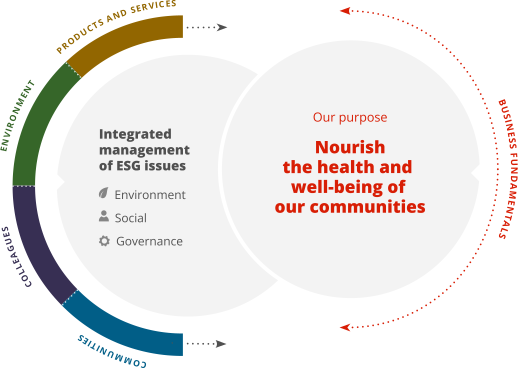
Managing key social issues is a shared responsibility of all stakeholders in society. Our 2022-2026 Corporate Responsibility (CR) plan constitutes an effective lever to contribute to these efforts and create value for METRO. Our ESG priorities are grouped under the four pillars of our approach and are supported by solid business fundamentals that ensure METRO's sound management and vitality.
Our priorities
 Responsible procurement
 Health, nutrition and well-being
 Packaging and printed materials
Climate change
Waste
Food Waste
Equity, diversity and inclusion
Socioeconomic contribution
Our business fundamentals
Product quality and safety
Employee health and well-being
 Data security
Responsible marketing
Ethics and integrity
Sound governance
Customer satisfaction
We identified the ESG issues for which our actions could make a difference and made them the eight priorities of our plan. Objectives were set out for each priority and are grouped under the four pillars of our approach: products and services, environment, colleagues and communities.
Responsible
procurement
Health, nutrition
and well-being
Packaging and
printed materials
Climate
change
Waste
Food
Waste
Equity, diversity
and inclusion
Socioeconomic
contribution
We introduce a new dimension to this plan: business fundamentals. These principles, which were clearly identified in the materiality analysis, are key ESG factors that are part of METRO’s day-to-day activities. They will be subject to disclosure, along with our priorities, in our corporate documents.
Product quality
and safety
Employee health
and well-being
Data
security
Responsible
marketing
Ethics
and integrity
Sound
governance
Customer
satisfaction
For more information about our approach, see our 2022-2026 Corporate Responsibility Plan (PDF)
METRO’s corporate responsibility governance is integrated into the Corporation’s management structure, led by the executive team. It relies on specific individuals throughout the decision-making and implementation processes, all under the oversight of the Board of Directors.
Board of Directors
Oversees the Corporation’s activities and disclosure related to corporate responsibility, including ESG matters through the Governance and Corporate Responsibility Committee. The Board approves corporate responsibility plans and reports.
See the Board of DirectorsExecutive Committee
Approves the corporate responsibility strategy and ensures priorities are aligned with the Corporation’s business strategy and the incentive plans of all relevant xecutives and employees, and that objectives are met.
See the management teamVice-Presidency, Public Affairs and Communications
Develops strategic corporate responsibility directives, supports the Vice Presidencies accountable for corporate responsibility plan programs, and reports on progress to the Executive Committee and to the Governance and Corporate Responsibility Committee.
In-house teams
Reporting to the Vice Presidents responsible for the programs in the corporate responsibility plan, the teams assigned to the initiatives ensure continuous progress by working toward established goals and targets. For specific priorities, including environment, climate change, equity, diversity and inclusion, responsible procurement, packaging and printed materials, and health and safety, specific working groups or committees have been set up to bring together stakeholders from different teams.
Visit the Governance section of our corporate website to learn more about our practices and policies

Corporate responsibility plan
Corporate responsibility reports
Environmental information
Policies and statements
Responsible procurement
Community investment
Human resources
Report of forced labour and child labour